Data and cloud operations / Detakai field note
Parquet stores the data, Delta governs the change
Delta Lake adds a transaction log, versioning, and schema enforcement on top of Parquet columnar files — a storage format plus a table protocol.
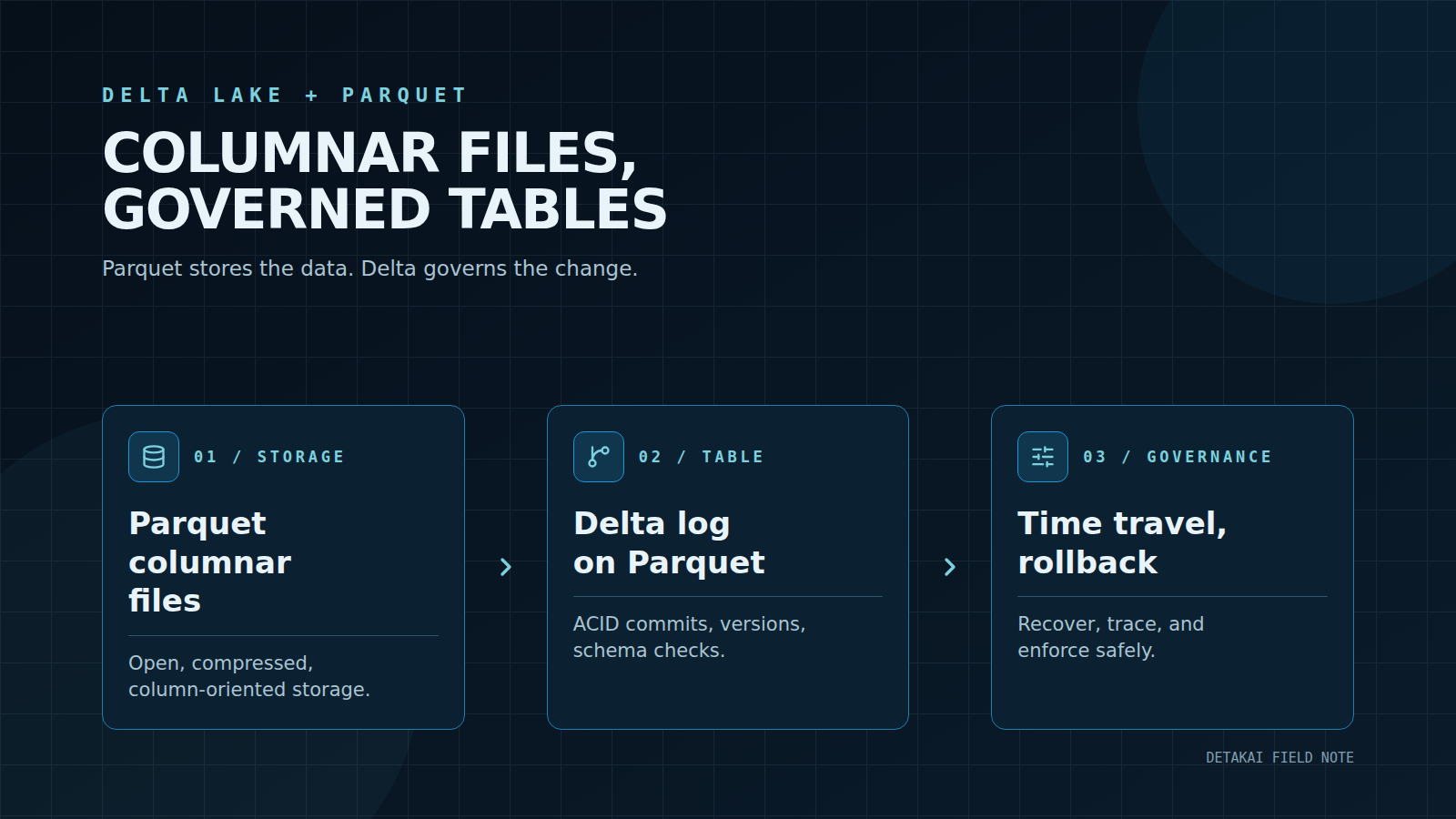
A Parquet file and a Delta table are often spoken about as if they were the same thing. They are not. Parquet is a storage format; Delta Lake is a table protocol that sits on top of Parquet files and governs how they change.
That distinction is not pedantic. It changes who can reason about cost, how schema drift is caught, and what “recover the data” actually means.
What Parquet is
Parquet is an open, column-oriented storage format. It stores rows of data by column rather than by row, which makes analytical scans that touch only a few columns far more efficient than row-wise formats.1
Three properties matter for platform teams:
- Columnar and compressed. Analytical queries read only the columns they need, so I/O and storage stay lower than row formats for typical BI and ML workloads.
- Open and portable. A Parquet file is a self-describing file you can read with many engines — it is not tied to one vendor’s runtime.
- Just storage. On its own, Parquet says nothing about transactions, history, or who changed what. A folder of Parquet files is data at rest, not a managed table.
That third point is where the confusion starts. A pile of Parquet files is not a table you can safely update concurrently.
What Delta Lake adds
Delta Lake is a table format (an open protocol) that adds a transaction log over a collection of Parquet files. The documented capabilities are ACID transactions, versioned snapshots (time travel), schema enforcement and evolution, and a single log that records every change.2
Think of it as three layers:
- Storage: the actual data still lives in Parquet columnar files.
- Log: a transaction log records commits, versions, and schema changes in order.
- Controls: the protocol enforces schema, exposes history, and supports rollback to prior versions.
The useful mental model is “Parquet stores the bytes; Delta governs the changes.” Removing Delta does not remove your data — the Parquet files remain — but it removes the guarantees about how those files may safely evolve.
Why the distinction matters for governance
Treating a Delta table as if it were just a file path leads to avoidable incidents:
- Cost attribution. Storage cost is the Parquet footprint; compute and version-retention cost come from how the table is written and how many snapshots are kept. Conflating them hides the real driver.
- Schema drift. Parquet files alone give you no enforced schema. Without the protocol’s checks, a bad write can land a column with the wrong type and silently break downstream readers.
- Recovery. “Restore the data” means different things for a file versus a table. Delta’s versioned log makes point-in-time recovery a protocol feature; a bare Parquet folder has no such history.
None of this is a performance claim. It is a governance claim: the protocol is what makes change safe, observable, and reversible.
The storage-to-table loop
The mature practice is a loop rather than a one-time setup:
write Parquet → record in the log → enforce schema → version and audit → recover or roll back.
Parquet supplies the efficient storage. Delta supplies the log, the enforcement, and the history. The organisation still has to decide retention, who can write, and what a safe change looks like.
For a FinOps or data-governance team, the unit to manage is not “a Parquet file” in isolation. It is a governed table: columnar storage plus a transaction log plus the controls that keep change reversible.
Note: This is an operating-model perspective based on the documented capabilities of the formats. It does not state client results, savings claims, or benchmark outcomes. The references below are canonical documentation URLs and were not fetched or verified during drafting — confirm them before publishing.
References
The following canonical documentation URLs are cited as the factual basis for the described capabilities. They could not be retrieved in this environment (web research tools were unavailable), so treat them as unverified and confirm each link before publishing.
Footnotes
-
Apache Parquet, “Apache Parquet” — the open columnar storage format. https://parquet.apache.org/ ↩
-
Delta Lake (The Linux Foundation), “Delta Lake Documentation” — open table format with ACID transactions, time travel, and schema enforcement. https://docs.delta.io/latest/index.html ↩